
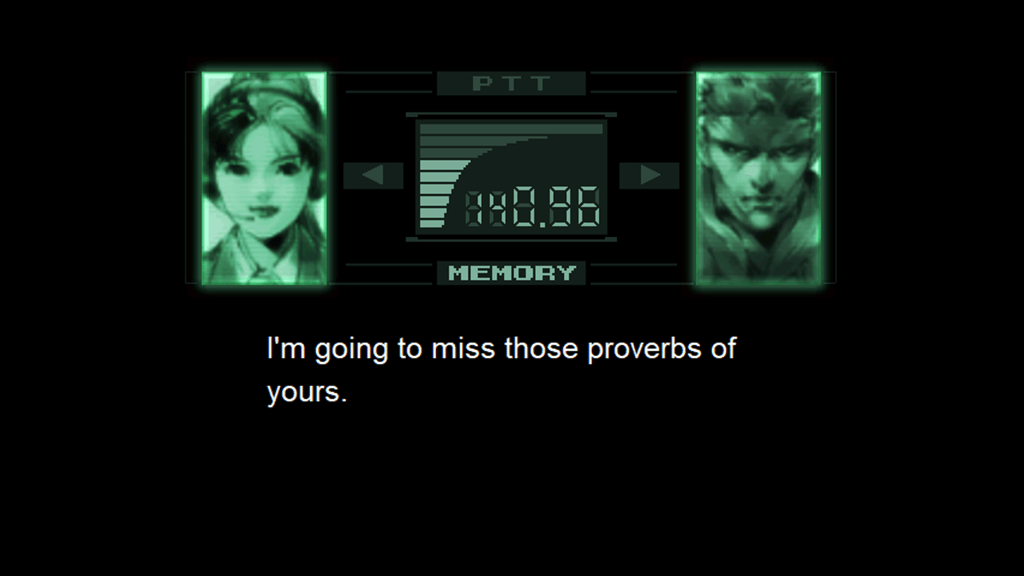
“I’m going to miss those proverbs of yours”
I do not like games where shooting a gun is the main action. Metal Gear Solid (MGS from here on) is a game about killing. You do shoot a gun. You kill people. Increasingly, you kill people you’d rather not kill. War is unavoidable. Killing is unavoidable. And yet, I love and will always defend the beauty of MGS because of how it uses all of this against the player. MGS is anti-war agitation propaganda, and its audience is the player who fires the gun.
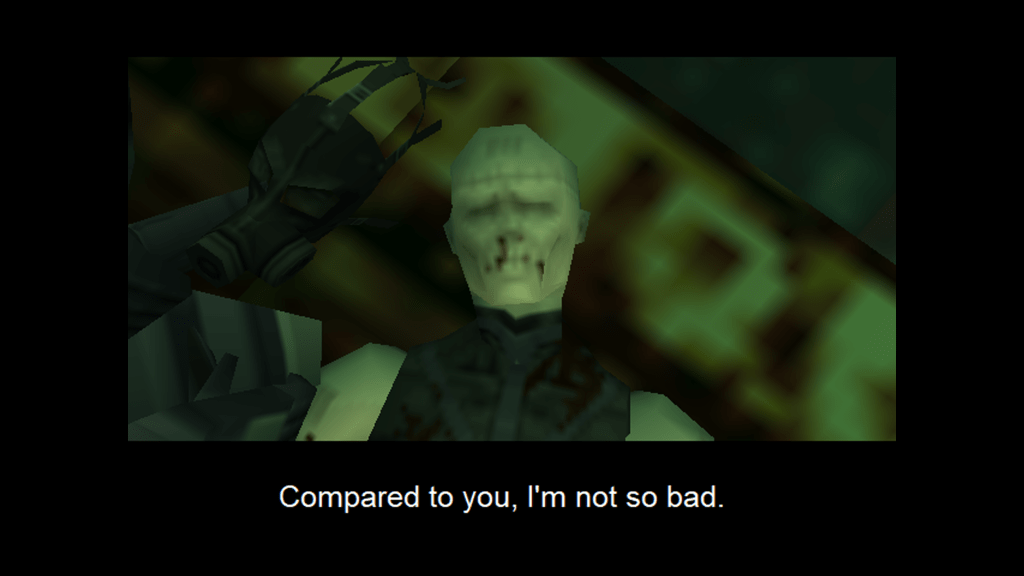
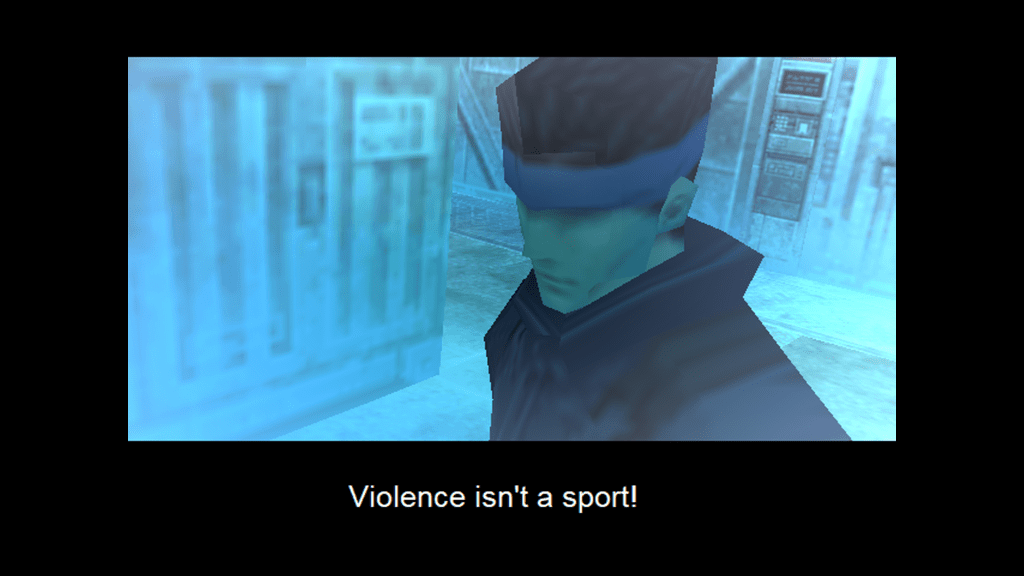
The first directive you get as a player is to avoid conflict. This is both because this game is much more about stealth and sneaking than running and gunning, but the game is that way because it want to drill into you that violent conflict is bad. In the early game, engaging in direct conflict will almost surely end in your death. Later, you avoid conflict as strategy; you’ll need that ammo for bosses. You are given some opportunities to mow down enemies, but they’re few and far between. A skilled player will kill very few enemies and end with a full inventory of bullets.
“It’s just like one of my japanese animes”
Metal Gear Solid wears its inspirations so visibly, you wonder if Kojima, the director and spearhead of the franchise, thinks metaphors are for cowards.
The narrative follows an episodic structure. There are no “levels” in MGS, and you can backtrack all you like, but acts of the story end with a boss fight where you win a key that unlocks new doors. Your narrative gift is is a flashback scene that explains the boss’ motivations, just like in so many battle-based anime. It’s a well-used trope that helps build empathy with the character you just shot to death.
The game begins similarly to The Rock: there’s an impregnable base where terrorists are holding hostages, and you are the only one who can get them out. That plot holds for about twenty minutes before the first of about ten major plot twists. Throughout, there are obvious references to Leon the Professional, and The Hunt for Red October. Character designs are lifted pretty much whole from Stargate and Escape from L.A.. When the plot nears its climax, we find ourselves in Gattaca town.
Perhaps one reason Metal Gear Solid was never optioned into a film itself is because 70% of its body—much like its director—is already made of movies.
These references point to films with their own ideas about war, violence, and messing with human beings in service of both.
“Haven’t you already killed most of my comrades?”
How to talk about war in an anti-war game.
Metal Gear is a giant robot that can shoot nuclear weapons, and the game tasks you fighting it on the ground with only the weapons you’ve picked up. But by the time you get there, you sort of feel like you can. The game escalates the weaponry in a very slick way. The first boss fight is just a gun duel with pistols. Get through that, and you fight a tank using grenades. Get through that, and eventually you fight a helicopter with a rocket launcher. By the end, the games makes you feel like you can fight the robot that carries nuclear weapons, because the games wants you to feel—with the help of your friends—you can stop nuclear weapons.
Just like how the game’s horniness is an echo of 90s action movies, so too is its affinity for specific weaponry. Every weapon is named in full. There’s a scene in a woman’s bathroom where Snake and Meryl casually chat about a Desert Eagle. The game wants you to know how good it is at weapons research. There’s an audience that wants this. It feels gross to me, but I’m not a gun person. But considering how anti-war this game is, I can’t help but wonder if that feeling of unease on purpose, too.
“I see that you enjoy Konami games!”
If getting a lecture on this stuff doesn’t sound like a good time, MGS undercuts all that seriousness with the goofiest, horniest fluff you’ve ever seen.
The Mantis boss fight is memorable for two things. In the original PlayStation version, mantis says names of games you might have saved on the memory card. This was very cool at the time. The other was having to swap your controller port from player one to player two. In the pc version, you have to play with the keyboard instead of a controller, which made for a fresh challenge for me.
I had a buddy who showed me some anime in early 97. Ghost in the shell and Fist of the North Star. I always appreciated that. But I think Otacon was the first time I heard the word “anime” said out loud by an adult character.
You’ll sneak past plenty of guards who are taking naps or sneezing because they caught a cold.
The cheekiest thing Snake does in the game is smuggle in a pack of cigarettes. Equipping them helped you see invisible lasers, but it also noticeably hacks away at your health bar. You can kill yourself smoking in Metal Gear Solid in less than a few minutes. This was excellent anti-smoking propaganda.
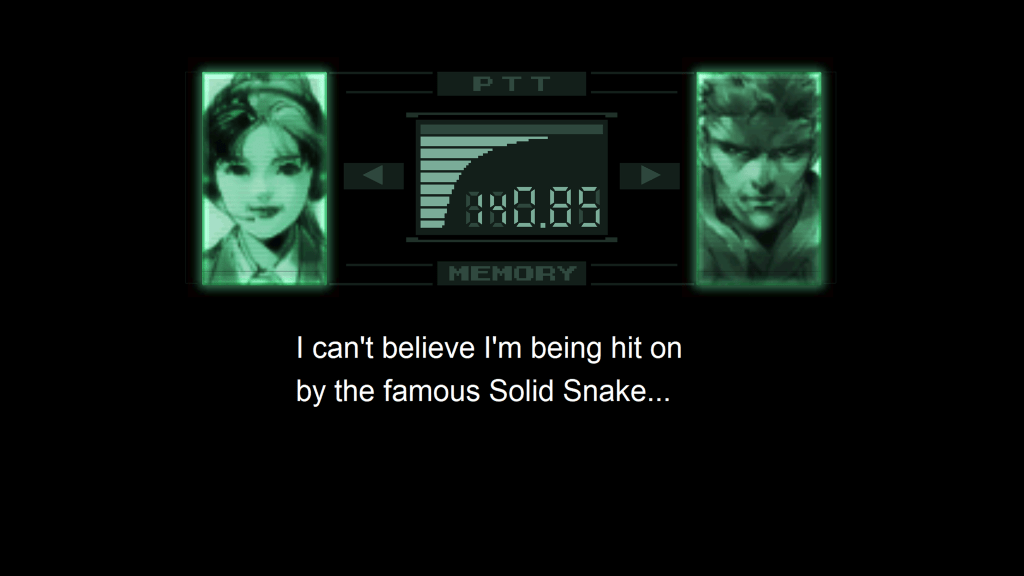
To save your game, you have to call Mei Ling, one of your remote teammates. Most times you save, she will give you a little advice or a wise proverb, but sometimes the two of you flirt.
Maybe my favourite goofball moment is when you walk into the room with like, a hundred cameras on the walls. This is so inefficient! Looney Tunes enemy design here.
And finally, most of the characters are horny in some way or another. Today, people just assume Kojima is a pervert, but really, I think it was just the 90s. I don’t know what to tell you. Every action movie was kind of like this. We’ve really chastened up, so Kojima games feel lewd now.
The levity is there to make the tragedy easier to swallow. MGS has good balanced writing whose tone holds up thirty years later.
“A ghost looking for a place to die”
There are three antagonists in Metal Gear Solid, and all of them are after you. Their trauma informs their decision making about how hard your day is going to be.
Liquid Snake wants you dead, but not until you’ve been useful. He represents the military industrial complex in that way, who also treats you the same way. After that, his sci-fi/ptsd-infused warrior philosophy has led him to a fistfight to the death with you.
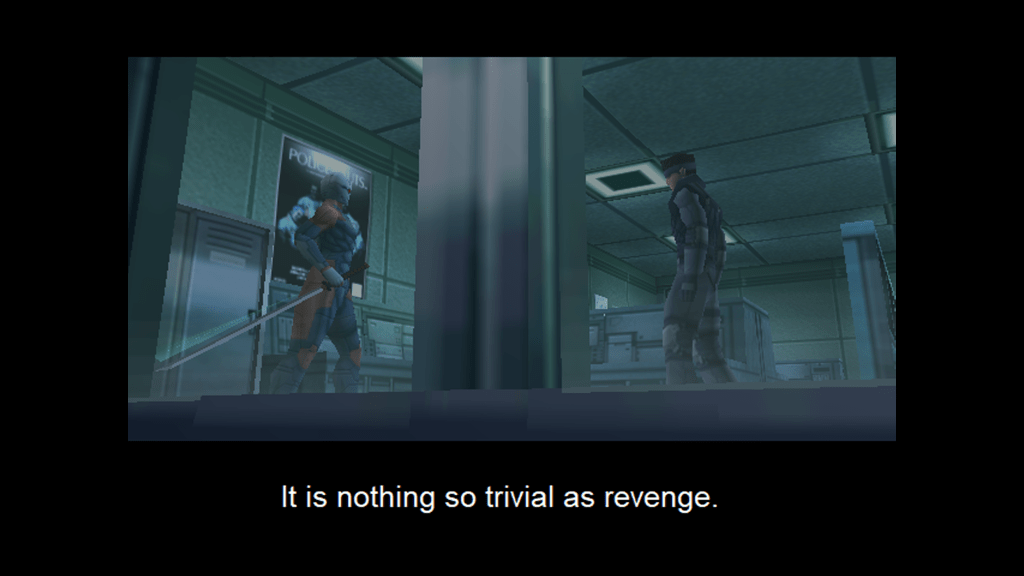
Grey Fox wants you dead, but only because his sci-fi/ptsd-infused warrior philosophy has led him to a fistfight to the death with you. He represents the kind of buy-in we have as soldiers and players. We are here for the fight. We are here for the killing.
The third antagonist doesn’t do any fist fighting, but they are responsible for most of the narrative deaths (you, of course, are responsible for the rest). They kill the other two antagonists, despite your best efforts. But they are also the only one whose philosophy changes in the narrative. They get to have the last words of the script, and that word is literally “live.”
“You can’t save anyone”
Despite Liquid Snake’s monologue about how useless your choices have been, the game sneakily lets you decide which of your comrades you will save.
The game rewards playing it again by giving you a bonus. If you are resist torture and save Meryl, you’re gifted with a bandana. Equip it as an item, and you’ll have unlimited ammunition for every gun. I’ve always taken this as a massively ironic gift from Meryl. When you first meet her, she has trouble firing a gun at all. Later, she’s taken out of the game by Sniper Wolf and held as a hostage. Being a good guy with a gun did not help her at all. I rarely ran out of ammunition on normal difficulty and find this to be an unhelpful item.
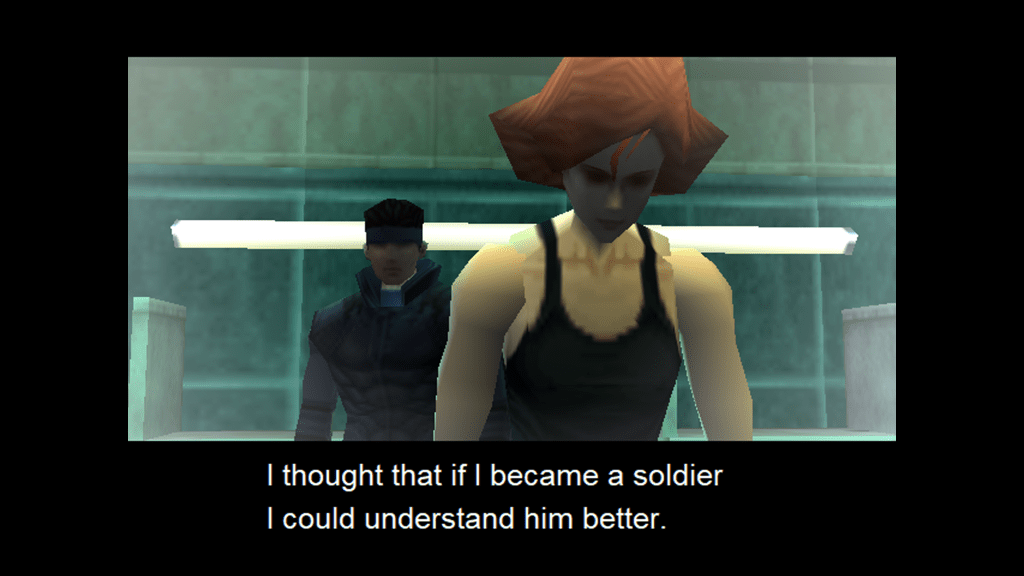
If you fail the torture sequence, you leave the game with Otacon instead, but the rewards is an invisibility suit. Because the game rewards sneaking and passive play, this makes playing through the story 100% easier. There’s a metaphor here, too: taking yourself out of things makes the game even less violent.
“What do you think that will do to the U.S.’s reputation?”
After the good/bad ending split, the game ends the same way, with an epilogue card about nuclear warheads in the real world.
“In the 1980s, there were more than 60,000 nuclear warheads in the world at all times. The total destructive power amounted to 1 million times that of the Hiroshima A-Bomb.”
“In January 1993, START2 was signed and the United States and Russia agreed to reduce the number of deployed strategic nuclear warheads to 3,000 to 3,5000 in each nation by December 31, 2000.”
“However, as of 1998, there still exist 26,000 nuclear warheads in the world.”
This is grim, of course. In three paragraphs, Kojima expresses a problem, an attempt at solving it, and that governments failed us.
So, as I’m sure all players of Metal Gear Solid do after finishing a run, I looked up the Federation of American Scientists’ Status of World Nuclear Forces. As of March 28, 2025:
Despite progress in reducing nuclear weapon arsenals since the Cold War, the world’s combined inventory of nuclear warheads remains at a very high level: nine countries possessed roughly 12,331 warheads as of the beginning of 2025.
We still have war, and we still have nukes. But we have less than half of the nukes that we did 27 years ago. That isn’t nothing. Of course, you can read that as a negative; 12,331 warheads isn’t zero warheads. But it’s better now than it was in 1998.


Leave a comment